
Just south of Osaka City lies Sakai, a city renowned for producing some of Japan’s finest kitchen knives. For centuries, craftsmen here have been forging blades known for their incredible sharpness and precision. Today, many professional chefs—both in Japan and abroad—continue to rely on knives made in Sakai.
The city’s knife-making tradition is not just about tools; it represents a deep cultural heritage shaped by generations of highly skilled artisans.
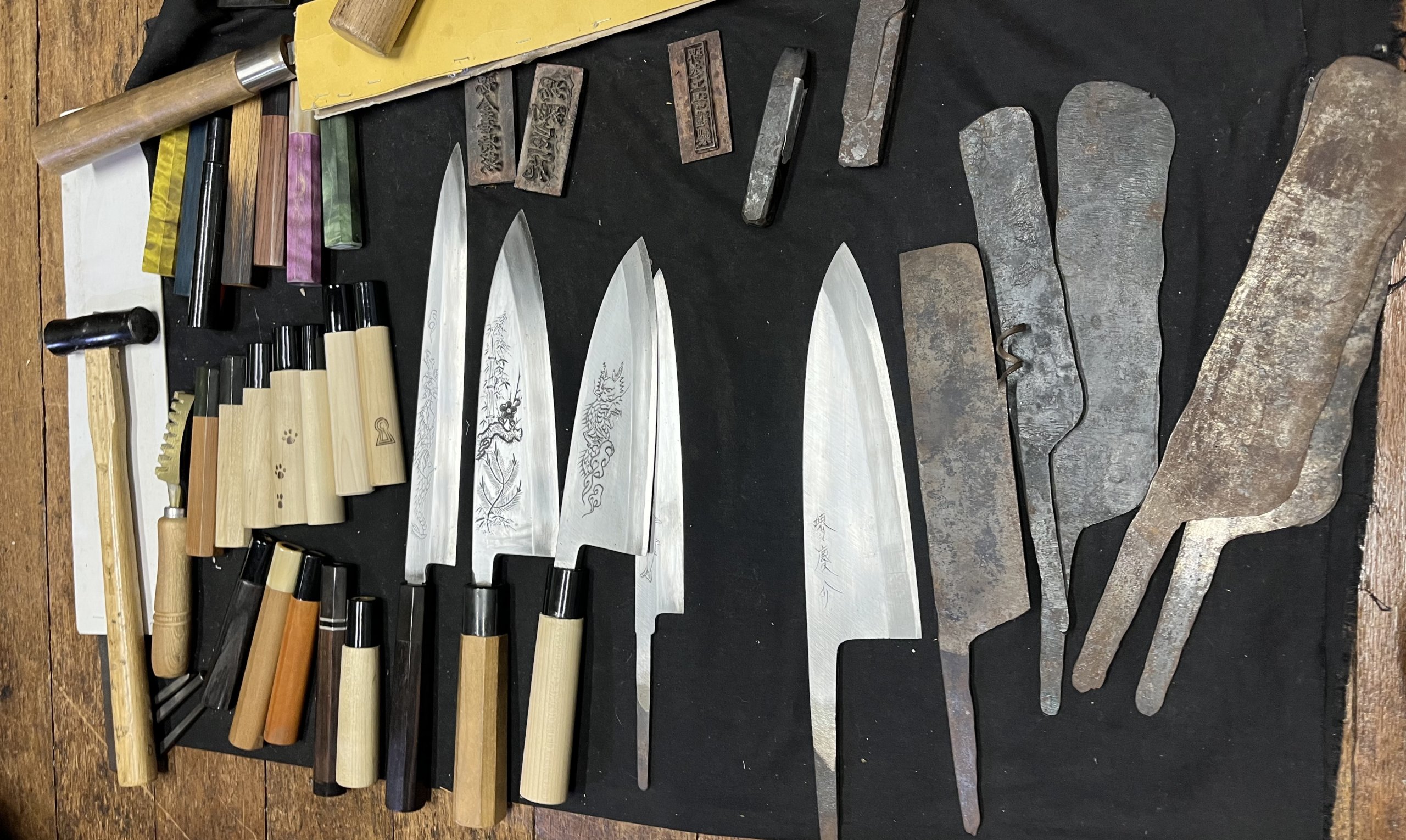
Finished Sakai knives displayed alongside blades in the forging process, highlighting the craftsmanship behind each piece.
The History of Sakai Knives
The origins of Sakai’s knife-making tradition date back to the 16th century. Long before kitchen knives became the city’s signature product, the area was already known for producing large numbers of iron farming and construction tools such as spades and hoes. Skilled metalworkers gathered in the region and formed communities of craftsmen, developing advanced forging techniques.
These skills were later applied to other types of metalwork, and during Japan’s Warring States period, Sakai became an important center for the production of firearms.

A historic gunsmith residence in Sakai, reflecting the city’s role as a center of firearms production during the Warring States period.
When tobacco was introduced to Japan in the late 16th century, Sakai craftsmen began producing specialized tobacco knives. Their high quality quickly gained recognition, and during the Edo period the Tokugawa shogunate granted Sakai knives an official seal of approval. This recognition helped establish Sakai as one of Japan’s most respected blade-making centers.
Over time, the skills developed for tobacco knives were adapted to produce kitchen knives, particularly those used by professional chefs.
The Division of Labor Behind Sakai Knives
Knives produced in Sakai are often referred to as Sakai Uchihamono, a traditional style of forged blades developed in Sakai and the surrounding area of Osaka. These knives are known for being made using traditional forging and sharpening techniques.
One distinctive feature of knife production in Sakai is its long-established division of labor. Rather than a single craftsman producing an entire knife, multiple specialists handle different stages of the process.
Blacksmith (Kaji)
The process begins with the blacksmith, who forges the blade from iron and steel through a technique known as forging. The metal is heated until it glows red in a blazing furnace and is then repeatedly hammered—sometimes using power hammers—to shape the blade.
A key feature of traditional Japanese knives is the combination of two types of metal. A hard steel called hagane forms the cutting edge, while a softer iron called jigane supports it. By bonding these materials together, the blade achieves both sharpness and flexibility.
This step determines the knife’s fundamental strength, structure, and cutting performance.

A blacksmith shaping a blade through traditional forging techniques, a key step in making Sakai knives.
Sharpener (Togishi)
After forging, the blade is passed to a sharpening specialist known as a togishi. Through a series of careful grinding and polishing steps, the sharpener creates the knife’s precise cutting edge.
The process begins with rough grinding using coarse whetstones to shape the blade and reduce the thickness near the edge. This is followed by finer sharpening stages that refine the blade’s surface and edge geometry.
The back side of the blade is also carefully polished to maintain balance and cutting efficiency. Once the sharpening is complete, the blade is finished with fine stones and coated with protective oil before being sent to the next craftsman.
Handle Makers (Etsuke and Handle Craftsmen)
The final stage is attaching the handle. In Sakai’s traditional system, this step also involves multiple specialists. One craftsman produces the wooden handle itself, while another—known as the etsuke artisan—fits the blade into it.
To attach the handle, the tang of the knife is heated and inserted into the wooden handle. Gentle taps with a wooden mallet allow the blade to slide naturally into place. The craftsman carefully aligns the blade so it sits perfectly straight and balanced.
Although this may appear simple, achieving the correct balance and alignment requires considerable skill and experience.
Because each step is handled by a specialist, the finished knives achieve an exceptional level of quality and precision. The system also improves production efficiency, as craftsmen focus on their specific tasks.

The final stage of production, where the blade is carefully fitted into a wooden handle for balance and precision.
Why Professional Chefs Value Sakai Knives
One reason Sakai knives are so highly regarded is their suitability for professional kitchens. Many knives made in Sakai have a single-sided edge, meaning the blade is sharpened only on one side. This design allows for extremely precise cuts and smooth slicing, which is essential for delicate tasks such as preparing sashimi or finely cut vegetables.
Because the blade can glide cleanly without crushing ingredients, single-sided knives are especially valued by professional chefs. Over time, Sakai became closely associated with high-level culinary work, and chefs across Japan came to rely on these knives for their precision and sharpness.
Today, Sakai knives continue to play an important role in Japanese culinary culture, linking the craftsmanship of Sakai with the traditions of Japanese cuisine.
Experience Sakai Knife Culture
Visitors to Sakai can enjoy hands-on workshops to experience traditional knife-making, including sharpening, handle attachment, and even museum visits. These experiences allow participants to observe skilled craftsmen in action and learn about the history and techniques behind Sakai knives. Workshops are available at various locations throughout the city.
One well-known example is Wada Shoten, where participants can choose from knives such as Santoku (a versatile multipurpose knife), Petty (small utility knife), Deba (heavy-duty fish/meat knife), and Sashimi knives in home-friendly sizes. Visitors can try sharpening and handle-fitting themselves, and even have their chosen knife personalized with their name at no extra cost. Reservations can be made through providers like Wabunka.
These hands-on experiences offer a rare opportunity to interact directly with skilled craftsmen and gain a deeper appreciation for the precision and artistry behind every Sakai knife.

A skilled craftsman demonstrates traditional knife sharpening techniques, showing the precision required to create the razor-sharp edge of Sakai knives.
How to Get to Sakai from Osaka City
Sakai is located just south of Osaka City and is easy to reach in about 15–20 minutes.
The most convenient way is by train from Namba Station using the Nankai Main Line. From Namba, you can take a train toward either Wakayama or Kansai Airport, and get off at Sakai Station. The journey usually takes around 15 minutes depending on the train.
From Sakai Station, the traditional knife shops and craft museums are within walking distance or a short taxi ride.
For a more relaxed, local experience, you can take the Hankai Tramway from stations such as Shin-Imamiya Station or Tennoji Station. This scenic tram ride takes about 30 minutes from Tennoji and brings you directly into Sakai’s historic districts. From stops near the tram line, attractions such as the Sakai Traditional Crafts Museum and Wada Shoten are within walking distance.

The Hankai Tramway offers a scenic and relaxed way to reach Sakai from Osaka city.
Once in Sakai, traditional knife shops, museums, and workshops are all easy to explore on foot or via a short taxi ride.
Because of its proximity to central Osaka, Sakai can easily be visited as a half-day trip while exploring the Kansai region.
Final Thoughts
Just a short trip from Osaka, Sakai offers a unique opportunity to explore one of Japan’s most respected craft traditions. From its centuries-old history and specialized craftsmanship to hands-on workshops where visitors can experience the process themselves, Sakai provides a deeper understanding of the artistry behind Japanese knives.
Whether you are interested in culinary culture, traditional crafts, or simply looking for a meaningful local experience, a visit to Sakai adds a distinctive and memorable dimension to any trip in the Kansai region.

tokie
最新記事 by tokie (全て見る)
- Shrine Animals to See in Kansai and what they mean - 30/03/2026
- Sakai Knives : History and Craftsmanship in Osaka - 19/03/2026
- Shodoshima : 3-day Slow Travel Itinerary - 11/03/2026